
Sikha stepped out of the shower and noticed something she’d been trying to ignore for weeks her bathroom floor was covered with strands of hair. She’s 34, and for the past few months, her hair has been thinning noticeably. When she took a selfie in the natural light, the gaps in her hair near her temples were undeniable.
But before you decide on a treatment, it’s important to understand what PRP and GFC actually are, how they work differently, and whether either (or both) might be suitable for your specific situation. If you are exploring PRP and GFC treatment in Cuttack, you’ll be pleased to know that advanced, reliable options are now available close to home. However, making an informed choice requires clarity on the science, the process, and the expected outcomes so you can move forward with confidence and realistic expectations.
What Is PRP Hair Treatment?
PRP stands for Platelet-Rich Plasma.
Here’s how it works in simple terms: Your blood contains tiny cells called platelets, which help your body heal wounds. When you have a cut, these platelets rush to the area and form a clot. But platelets do more than stop bleeding they also release special proteins called growth factors that help repair damaged tissue.
How PRP Is Prepared
During a PRP hair treatment session:
- A small blood sample is drawn from your arm (similar to a blood test)
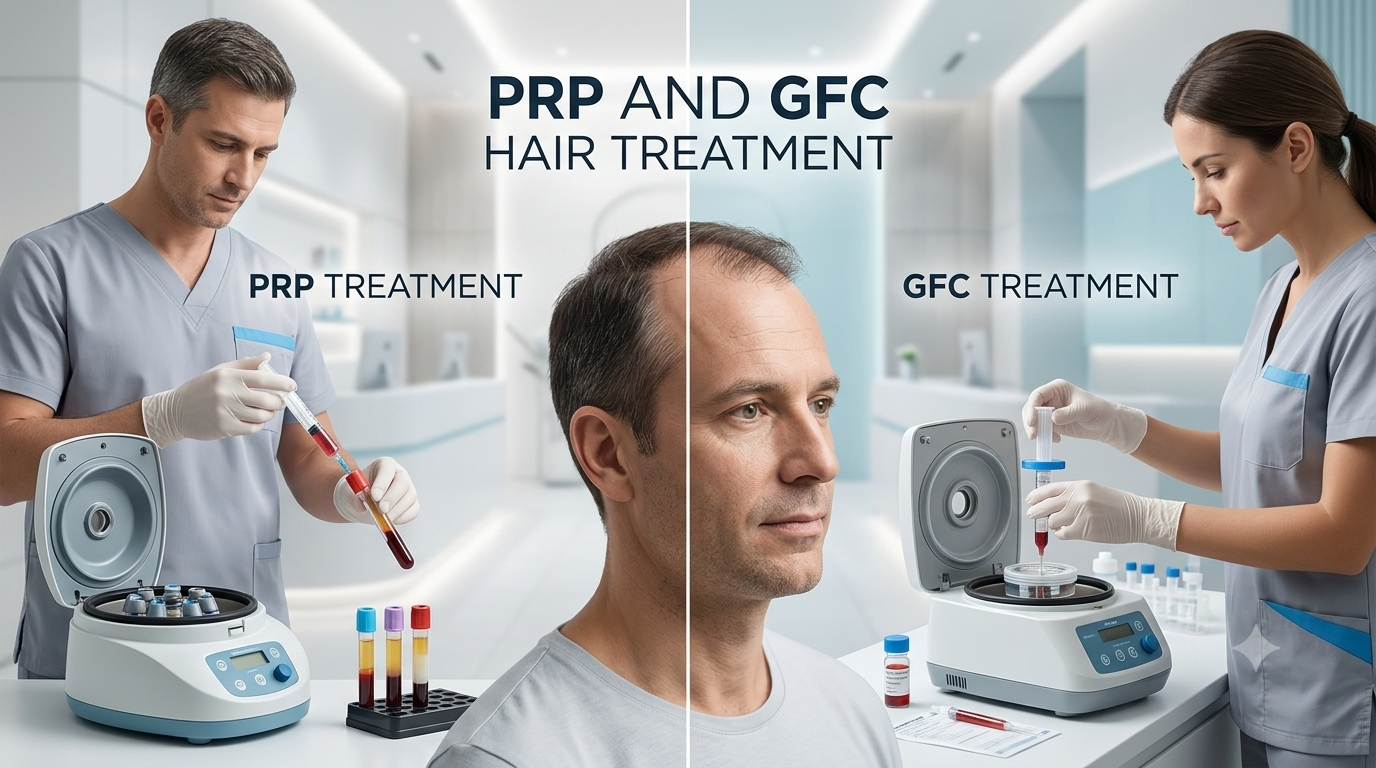
- The blood is placed in a centrifuge a machine that spins at high speed to separate different components of your blood
- Platelets are isolated from the rest of your blood, creating a concentration of platelet-rich plasma
- The PRP is collected and prepared for injection
The entire process usually takes 20-30 minutes.
How PRP Is Administered
Once the PRP is ready, a doctor injects it directly into the scalp where hair is thinning or falling. The injections are typically given in multiple spots across the affected area. While there may be mild discomfort, most people manage it well, and the procedure doesn’t require anaesthesia.
How PRP Supports Hair Growth
The growth factors in PRP are believed to:
- Reduce inflammation in the scalp
- Improve blood circulation to hair follicles
- Stimulate dormant hair follicles to enter the active growth phase
- Strengthen existing hair and reduce breakage
What Is GFC Hair Treatment?
GFC stands for Growth Factor Concentrate.
While PRP uses the growth factors naturally present in your blood platelets, GFC is a more refined approach. Instead of just concentrating platelets, GFC involves extracting and concentrating multiple growth factors from your own blood plasma.
How GFC Differs From PRP
The key difference is in preparation:
- PRP separates and concentrates platelets, which contain growth factors
- GFC takes the process further by extracting the actual growth factors themselves, creating a higher concentration of these healing proteins
This means GFC may contain more potent healing and regenerative elements compared to standard PRP.
How GFC Is Prepared
The preparation is similar to PRP but includes an additional filtration step:
- A small blood sample is drawn
- The blood is processed in a centrifuge
- Growth factors are separated and concentrated from the plasma
- The concentrated growth factors are isolated and prepared for injection
How GFC Is Administered
Like PRP, GFC is injected directly into the scalp at multiple points. The procedure is non-invasive, requires no downtime, and most people can return to their daily activities immediately.
PRP vs GFC: What Is the Difference?
| Aspect | PRP (Platelet-Rich Plasma) | GFC (Growth Factor Concentrate) |
| Source | Your own blood | Your own blood plasma |
| Preparation | Centrifugation to isolate platelets | Centrifugation + filtration to isolate growth factors |
| Main Components | Platelets containing growth factors | Concentrated growth factors |
| Concentration Level | Standard platelet concentration | Higher concentration of growth factors |
| Procedure Length | 20-30 minutes | 30-45 minutes |
| Expected Experience | Minimal discomfort, mild redness may follow | Minimal discomfort, mild redness may follow |
| Potential Benefits | May reduce hair fall, improve scalp health, stimulate growth | May reduce hair fall, improve scalp health, stimulate growth |
| Number of Sessions | Typically 3-4 initial sessions (spaced 4-6 weeks apart) | Typically 3-4 initial sessions (spaced 4-6 weeks apart) |
| Maintenance | Annual or bi-annual top-up sessions may be advised | Annual or bi-annual top-up sessions may be advised |
| Cost Range | ₹10,000–₹20,000 per session (varies by clinic) | ₹15,000–₹30,000 per session (varies by clinic) |
| Suitability | Early to moderate hair loss | Early to moderate hair loss |
How Does PRP Work for Hair Loss?
Hair loss often involves inflammation and reduced blood flow to the scalp. When hair follicles don’t receive adequate nutrients and oxygen, they weaken and eventually stop producing new hair.
PRP addresses this by:
- Reducing scalp inflammation – Growth factors in PRP have anti-inflammatory properties
- Improving blood circulation – Better nutrient and oxygen delivery to hair follicles
- Activating dormant follicles – Growth factors signal hair follicles to shift from a resting phase to an active growth phase
- Strengthening existing hair – Better scalp health means stronger hair shaft and reduced breakage
The goal isn’t to create new hair follicles (which PRP cannot do), but rather to revive existing follicles that have become weak or inactive.
How Does GFC Work for Hair Loss?
GFC works on similar principles but with a higher concentration of growth factors, which may theoretically lead to:
- Stronger anti-inflammatory effects
- More potent stimulation of hair follicle growth
- Faster tissue repair within the scalp
- Better overall scalp regeneration
The refined concentration of growth factors means that fewer injections may achieve similar results, and some patients report faster visible improvement compared to standard PRP. However, individual results vary significantly.
PRP vs GFC: Which One Is Better for Hair Loss?
Here’s the honest answer: There is no one-size-fits-all treatment.
The question isn’t really “Which is better?” but rather “Which is better for me?”
Factors That Influence Your Best Choice
1. Cause of Your Hair Loss
- Hereditary pattern hair loss (androgenetic alopecia) may respond differently than hair loss from stress, nutritional deficiency, or scalp conditions
- A proper diagnosis is essential before choosing any treatment
2. Severity and Stage
- Early-stage hair thinning may respond well to PRP
- More advanced hair loss might benefit from combining PRP or GFC with other treatments
3. Your Age
- Younger patients with early hair loss may see better results than older patients with advanced baldness
- Hair follicles that have been dormant for many years may be harder to reactivate
4. Current Hair Density
- If you still have hair in thinning areas, both treatments may help
- If the area is completely bald (no visible hair), results are less predictable
5. Scalp Condition
- Patients with good scalp health typically respond better to regenerative treatments
- Existing scalp infections or severe dandruff should be treated first
6. Overall Health
- Certain medical conditions or medications can affect treatment outcome
- This is why your doctor’s assessment is crucial
7. Previous Treatment History
- If you’ve tried other treatments before, this affects current suitability
- Some patients combine PRP or GFC with topical medicines for better results
Why Diagnosis Comes Before Treatment Selection
Imagine going to a tailor without knowing your exact measurements and asking them to make a suit. It might fit, or it might not. The same applies to hair treatments.
A qualified dermatologist will:
- Examine your scalp closely
- Assess your hair density and loss pattern
- Review your medical history
- Possibly recommend blood tests to check for nutritional deficiencies
- Identify the underlying cause of your hair loss
- Then recommend the most suitable treatment (or combination of treatments)
Who May Consider PRP?
PRP is generally suitable for:
- People with early to moderate hair thinning
- Those experiencing gradual hair loss rather than sudden, patchy loss
- Patients with adequate remaining hair in thinning areas
- People seeking a non-surgical treatment option
- Those who prefer a lower-cost entry point into regenerative treatments
- Patients with pattern hair loss (androgenetic alopecia)
- Individuals who want to combine PRP with other treatments (medications, topical solutions)
Who May Consider GFC?
GFC may be considered by:
- Patients who didn’t respond well to standard PRP
- Those with moderate hair loss wanting a higher concentration of growth factors
- People willing to invest more financially for potentially faster results
- Patients seeking fewer injection sessions due to higher potency
- Those with scalp conditions requiring stronger regenerative support
PRP and GFC: Are There Any Side Effects?
Both treatments use your own blood, making them very safe with minimal risk of allergic reactions or rejection. However, like any injectable procedure, there can be temporary effects:
Common Temporary Effects
- Mild pain or discomfort at injection sites (usually minimal)
- Redness around injection points (usually fades within hours)
- Swelling or puffiness on the scalp (typically resolves within 24-48 hours)
- Tenderness in the treated area
- Temporary scalp sensitivity or itching
Important Notes
- These effects are temporary and typically resolve within a few days
- Individual experiences vary some people have no side effects, while others experience mild symptoms
- Serious complications are rare when performed by qualified professionals
- It’s important to discuss any existing medical conditions, medications, or allergies with your doctor before treatment
If you have a bleeding disorder, take blood thinners, or have active scalp infections, inform your doctor before proceeding.
How Many Sessions May Be Needed?
Both PRP and GFC typically require multiple sessions for noticeable results.
Typical Treatment Schedule
- Initial phase: 3-4 sessions spaced 4-6 weeks apart
- Maintenance: Annual or bi-annual touch-up sessions may be recommended to maintain results
- Individual variation: Some people may need more or fewer sessions depending on their response and severity of hair loss
Your doctor will assess your progress after the initial sessions and advise whether additional treatments are beneficial.
When Can You Expect Results?
This is perhaps the question every patient asks, and it’s important to have realistic expectations.
Hair Growth Timeline
- Weeks 1-4: No visible changes (the scalp is healing and growth factors are working at the cellular level)
- Weeks 4-8: Some patients notice reduced hair fall
- Weeks 8-12: Hair quality may improve (hair feels thicker, smoother)
- Weeks 12-16+: New hair growth or increased hair density may become visible
Why This Takes Time
Hair has a natural growth cycle. When a follicle is activated by growth factors, it doesn’t instantly produce new hair. The follicle must first enter an active growth phase, and then the hair shaft must grow through the scalp a process that naturally takes several months.
Individual Variation
- Some people see results by 3 months; others take 6+ months
- Results depend on the cause of hair loss, age, severity, and individual healing response
- Patience is essential—premature judgment (like at 6 weeks) may be disappointing
PRP vs GFC Cost: What Should Patients Consider?
Why Costs Vary
Treatment costs can differ significantly based on:
- Clinic reputation and location – Premium clinics or those in tier-1 cities may charge more
- Technology and equipment – Advanced centrifugation systems may cost more
- Doctor’s expertise – Experienced hair-restoration specialists may charge higher fees
- Number of sessions – Treatment packages vary
- Individual requirements – Extent of hair loss affects number of injections needed
Typical Cost Range in India
- PRP per session: ₹10,000–₹20,000
- GFC per session: ₹15,000–₹30,000
- Complete initial treatment (3-4 sessions): ₹40,000–₹80,000 for PRP; ₹60,000–₹1,20,000 for GFC
Can PRP or GFC Completely Stop Hair Loss?
The Realistic Answer
PRP and GFC may slow down hair loss and improve hair quality, but they are not permanent cures for hair loss.
Here’s why:
- They treat the symptom, not always the cause – If your hair loss is caused by heredity, these treatments help but don’t change your genetic predisposition
- They require ongoing maintenance – Unlike a surgery, results fade if you stop treatment
- Advanced hair loss is harder to reverse – If follicles have been dormant for years, reactivating them is challenging
- Combined approach often works best – PRP or GFC alone may not be enough; combining with medications (like minoxidil) often produces better results
A Broader Hair Loss Management Plan
Effective hair loss treatment usually involves:
- Identifying the cause – Nutritional deficiency? Hormonal? Genetic? Stress-related?
- Addressing root causes – Fixing diet, managing stress, treating scalp conditions
- Using regenerative treatments – PRP or GFC to revive existing follicles
- Topical or oral medicines – To slow down hair loss and support regrowth
- Lifestyle changes – Better sleep, reduced stress, adequate protein intake
- Ongoing maintenance – Regular follow-ups and touch-up sessions
Why a Hair Loss Diagnosis Matters Before Choosing PRP or GFC
Before booking your PRP or GFC appointment, get a proper diagnosis.
Why This Matters
- Different causes require different approaches – Hair loss from nutritional deficiency won’t improve with injections alone if you don’t fix the diet
- Saves time and money – If the cause isn’t addressed, even good treatments won’t work optimally
- Helps set realistic expectations – Your doctor can tell you what’s actually achievable in your specific situation
- Identifies hidden conditions – Sometimes hair loss signals an underlying health issue (thyroid problems, autoimmune conditions, etc.)
What a Hair Loss Evaluation Typically Includes
- Detailed medical history
- Scalp examination (sometimes with magnification)
- Hair pull test or trichogram (examining hair strands under microscope)
- Blood tests (to check thyroid, iron, vitamin D, protein levels)
- Assessment of hair loss pattern and severity
PRP or GFC: Making the Right Decision
If you’re experiencing hair thinning, excessive shedding, or a receding hairline, here’s how to make a decision:
Step 1: See a dermatologist or hair specialist Get a proper diagnosis. Don’t self-diagnose based on what you read online or what worked for your friend.
Step 2: Understand your specific situation Learn the cause of your hair loss and its severity. Discuss your expectations with your doctor.
Step 3: Explore your options Your doctor may recommend PRP, GFC, medications, lifestyle changes, or a combination. Be open to this guidance.
Step 4: Choose based on professional advice, not marketing Don’t let advertisements or social media influence your choice. Trust your doctor’s assessment based on your individual case.
Step 5: Commit to the process If you proceed with treatment, complete the recommended sessions and follow aftercare instructions. Hair regeneration takes time.
PRP vs GFC: Final Thoughts
- Both are safe, non-invasive treatments using your own blood
- GFC may offer higher growth factor concentration than PRP
- Neither is a “miracle cure,” but both may help if you’re suitable
- Individual results vary widely
- Professional diagnosis is essential before choosing any treatment
The “better” treatment is the one that’s right for you—and only a qualified doctor can determine that.
Frequently Asked Questions
1. Is PRP better than GFC for hair loss?
Not necessarily. PRP and GFC work on similar principles, but GFC offers a higher concentration of growth factors. Some patients respond better to GFC, while others see good results with PRP. The “better” option depends on your specific condition, medical history, and how your body responds.
2. Is GFC treatment painful?
No. While you may feel mild discomfort or slight pinching during injections, GFC is not painful. Most patients tolerate the procedure well without anaesthesia. Any discomfort is brief and resolves immediately after the procedure.
3. How long does a PRP or GFC session take?
A PRP session typically takes 20-30 minutes, while a GFC session may take 30-45 minutes due to the additional processing step. However, this is just the treatment time—you should budget extra time for consultation and aftercare instructions.
4. Can women undergo PRP or GFC treatment?
Absolutely. Both treatments are suitable for women experiencing hair loss. In fact, many women use these treatments for various types of hair thinning, including pattern hair loss and telogen effluvium (stress-induced hair loss). Always inform your doctor if you’re pregnant or breastfeeding.
5. Can PRP and GFC be combined with other hair-loss treatments?
Yes. Many doctors recommend combining regenerative treatments with topical minoxidil or oral medications for better results. Some patients also combine PRP/GFC with low-level laser therapy or other treatments. Your doctor can advise on the best combination for your situation.
6. How soon can results be noticed?
Most patients notice reduced hair fall within 8-12 weeks and visible improvement in hair density and quality within 4-6 months. However, this varies. Some see results earlier; others take longer. Patience is essential.
7. Are PRP and GFC suitable for advanced hair loss (near baldness)?
Results are less predictable in advanced hair loss where hair follicles have been dormant for years. These treatments work best on early to moderate hair loss where hair follicles still exist but are weakened. If you have complete baldness in an area with no hair, consult your doctor about realistic expectations or alternative options like hair transplantation.
8. Do PRP or GFC treatments work for everyone?
No. While most people with early to moderate hair loss see some improvement, results aren’t guaranteed. Factors like age, cause of hair loss, scalp condition, and individual healing response influence outcomes. This is why professional evaluation is crucial your doctor can honestly assess your likelihood of benefit.
Worried About Hair Loss? Get an Expert Consultation
Hair loss can be frustrating and affect your confidence. But you’re not without options. Whether you choose PRP, GFC, medications, or a combination approach, the key is to make an informed decision based on professional evaluation, not marketing hype or what others have tried.
If you are considering PRP and GFC treatment in Cuttack, it is essential to consult a qualified expert who can assess your unique hair and scalp condition, understand your medical history, and recommend a personalized treatment plan tailored to your needs. What works for one person may not work for another, and that is why professional guidance makes all the difference.
Dr. Chinmayee Kar is a trusted hair transplant and trichology expert dedicated to helping individuals regain their confidence through evidence-based hair restoration solutions. With extensive experience in advanced hair care techniques, Dr. Kar specializes in both surgical and non-surgical treatments, including PRP therapy, GFC therapy, and hair transplant procedures. Her patient-centric approach ensures that every individual receives compassionate care, clear communication, and realistic expectations throughout their hair restoration journey.
For those seeking expert advice and world-class PRP and GFC treatment in Cuttack, you can visit:
Pearl Hair Transplant
Address: Near Reliance Fresh, CDA Sector VI, Cuttack, Odisha 753014
Call: 7008801645
Book an Appointment
Take the first step toward healthier, fuller hair. Schedule a consultation today and discover a treatment plan designed just for you.
Disclaimer :- The information provided in this blog is intended for general educational and informational purposes only. It is not intended to replace professional medical advice, diagnosis, or treatment from a qualified healthcare professional.
