
Rohan had been noticing more hair on his pillow for months. He tried oils, shampoos, and even a few supplements he found online. Nothing worked. Frustrated, hoping for a quick fix. But what he actually needed wasn’t a product. It was an answer to a simpler question: why was his hair falling out? If you have ever searched for the best hair loss treatment near me after noticing more hair in your brush or on your pillow, you are not alone. Millions of people do the same thing every day. Hair loss does not have one universal cause, and it certainly does not have one universal treatment. The right approach depends entirely on what is driving the loss. Understanding this is the first step toward finding a solution that actually works for you.
Why Diagnosing Hair Loss Matters
When hair starts thinning or shedding, the instinct is often to try the most popular remedy. But treating hair loss without knowing its cause is like taking medicine without a diagnosis—it may not help, and it could waste time and money.
Several conditions can cause hair loss, and each may respond differently to treatment:
- Genetic hair loss (androgenetic alopecia) — pattern baldness influenced by genetics and hormones.
- Hormonal changes — thyroid disorders, PCOS, or menopause-related shifts.
- Nutritional deficiencies — low iron, vitamin D, or vitamin B12.
- Stress-related shedding (telogen effluvium) — temporary hair fall following illness, surgery, or emotional stress.
- Scalp conditions — infections, psoriasis, or seborrheic dermatitis.
- Certain medications — some drugs can trigger hair shedding as a side effect.
- Autoimmune-related hair loss — such as alopecia areata.
A proper diagnosis helps a specialist identify which of these—or which combination—may be affecting you. It also helps rule out serious conditions that require medical attention. As one clinical review notes, evaluating hair loss requires a thorough understanding of the various causes and practical knowledge of hair and scalp health, with a systematic approach to history, examination, and specialized testing .
What Happens During a Hair Loss Diagnosis?
A professional hair loss evaluation is more detailed than a quick glance at your scalp. It typically includes:
- Medical and family history — when the loss started, how quickly it progressed, and whether relatives have similar issues.
- Hair-loss pattern assessment — whether the loss is diffuse, localised, or follows a specific pattern.
- Scalp examination — looking for redness, scaling, inflammation, or other signs of scalp disease.
- Hair density and follicle assessment — evaluating how many hairs are present in a given area.
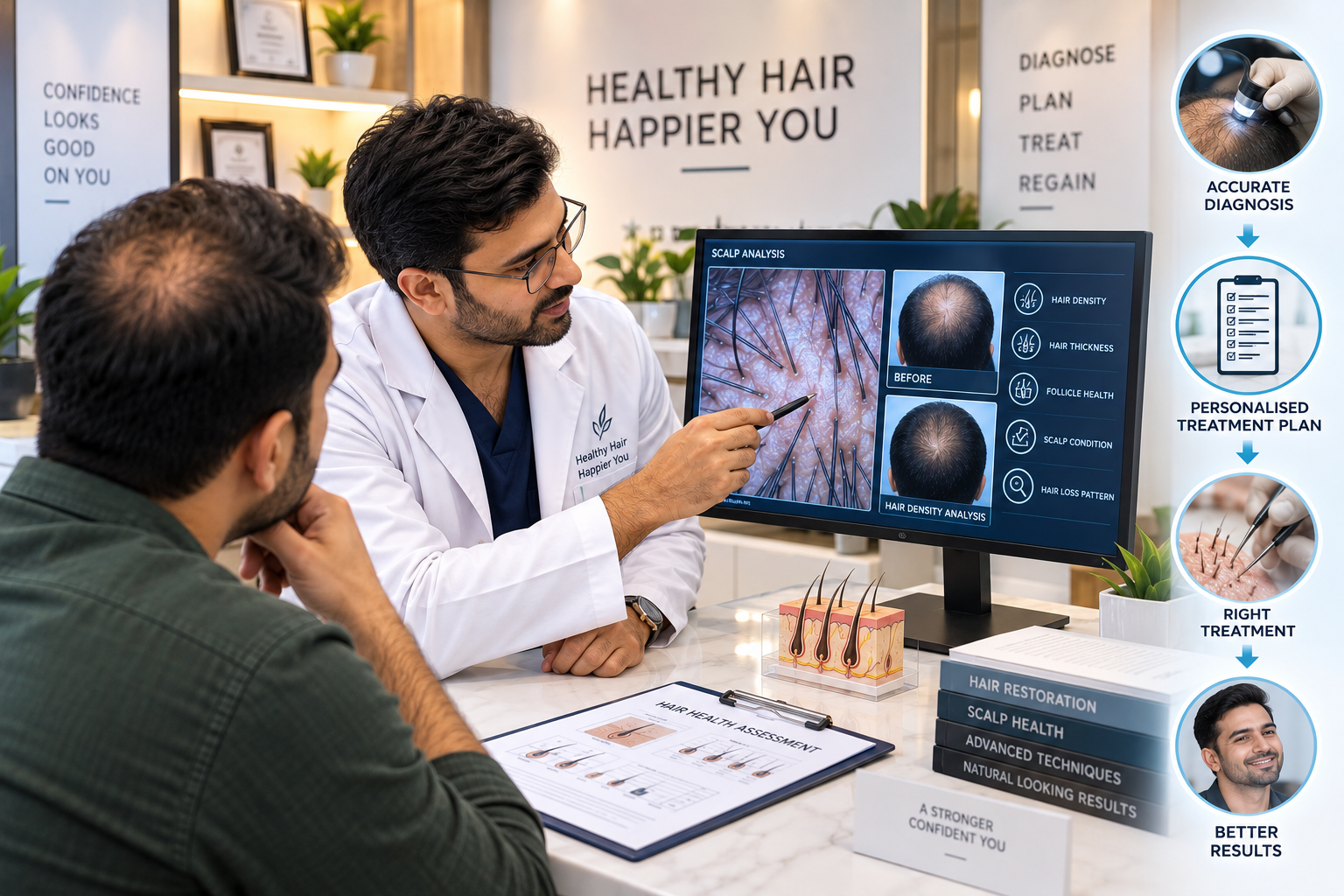
- Digital scalp analysis or trichoscopy — a specialized magnified view of the scalp and hair follicles. Research shows trichoscopy significantly improves diagnostic accuracy by identifying patterns in scarring and non-scarring alopecia .
- Blood tests when clinically indicated — commonly including CBC, thyroid function, ferritin, and vitamin D, though the exact tests depend on your individual situation .
Not every patient needs every test. The diagnostic approach is tailored to your symptoms, history, and suspected cause.
How Diagnosis Helps Determine the Right Treatment
Once the cause is identified, treatment becomes far more targeted. Here are some examples:
- Nutritional deficiencies → correction under professional guidance, often through dietary changes or supplementation.
- Pattern hair loss → medically appropriate therapies such as topical minoxidil or oral finasteride for suitable candidates .
- Scalp disorders → treatment of the underlying scalp condition, which may resolve the associated hair loss.
- Significant thinning with viable follicles → evaluation for hair restoration options.
- Advanced or permanent hair loss → assessment for hair transplant when appropriate.
This is why personalized hair loss treatment matters. Two people with hair fall may need completely different approaches based on their age, hair-loss pattern, duration, family history, scalp condition, and overall health.
Why Personalized Hair Loss Treatment Is Important
Two people with hair fall may require entirely different approaches. Factors such as age, hair-loss pattern, duration of loss, family history, scalp condition, hair density, overall health, and treatment goals all influence what will work best.
Personalization is more important than simply choosing the most expensive treatment. A targeted plan based on accurate diagnosis is more likely to deliver meaningful results than a generic approach.
When Should You See a Hair Specialist?
Professional evaluation is advisable if you notice:
- Sudden increase in hair shedding
- Rapid hair thinning
- A receding hairline
- Bald patches
- Itchy, painful, or inflamed scalp
- Hair loss accompanied by other symptoms
- Hair fall continuing for several months
- Noticeable reduction in hair density
A hair fall consultation can help determine whether your symptoms require medical treatment or simply lifestyle adjustments.
Frequently Asked Questions About Hair Loss Diagnosis
1. What is the first step in diagnosing hair loss?
Ans :- The first step is a consultation with a qualified professional who will take your history, examine your scalp, and determine whether further tests are needed.
2. Can a hair specialist identify the cause of hair fall?
Ans :- Yes. A specialist can identify many common causes through clinical examination and, when appropriate, blood tests or scalp analysis.
3. Is scalp analysis useful for hair loss?
Scalp analysis, including trichoscopy, can reveal patterns that help distinguish between different types of hair loss and guide treatment.
4. Does everyone with hair loss need a hair transplant?
Ans :- No. Many types of hair loss respond to medical treatment. Hair transplant is typically considered for specific patterns of permanent hair loss.
5. How do I find the best hair loss treatment near me?
Ans :- Look for a qualified specialist who performs a proper diagnosis before recommending treatment, offers personalized plans, and explains expected outcomes clearly.
Conclusion
Hair loss is a symptom, not a diagnosis. Finding the best hair loss treatment clinic starts with understanding why your hair is falling out. A proper diagnosis helps your specialist recommend a targeted approach—whether that involves medical treatment, lifestyle changes, or procedural options.
If you are experiencing persistent hair fall, thinning, or other concerning changes, consult a qualified hair specialist in Cuttack for a thorough evaluation. An accurate diagnosis is the most reliable path to the right treatment for your individual needs.
Searching for the Hair Diagnosis Treatment: Pearl Hair Transplant Is Your Right Place
If you have been searching for the best hair loss treatment near me, Pearl Hair Transplant in Cuttack offers comprehensive hair diagnosis and personalized treatment plans. With experienced specialists, proper scalp analysis, and a patient-first approach, they help you understand the root cause of your hair loss and find the right solution—without false promises.
Visit Pearl Hair Transplant
Address :- near Reliance Fresh, CDA Sector VI, Kataka, Odisha 753014
Visit Location :- https://maps.app.goo.gl/GyCgoSHWrvJdSrXPA
Book an appointment today and get a proper hair treatment
Disclaimer :- The information provided in this blog is intended for general educational and informational purposes only. It is not intended to replace professional medical advice, diagnosis, or treatment from a qualified healthcare professional.
