


It often begins without warning. One morning, you notice a few extra strands on your pillow. During your bath, the drain seems to collect more hair than usual. Or perhaps, while standing in front of the mirror, you see your scalp peeking through where your hair used to be thick and full.
These moments can be unsettling. The natural instinct is to look for a quick fix—a shampoo, an oil, or a remedy recommended by a friend or an advertisement. But hair loss is rarely simple. It can have many different causes, and what works for one person may not work for another. That is why understanding the underlying cause of your hair loss is the most important first step toward finding a suitable treatment.
If you are experiencing hair fall and looking for hair fall diagnosis in Cuttack, the journey to healthier hair begins with a professional assessment, not a hurried decision.
Why Is Hair Loss Diagnosis Important?
Hair loss is not a single condition. It is a symptom with multiple possible causes. Treating it without understanding the root cause is like taking medicine for a fever without knowing if it’s caused by an infection, a virus, or something else entirely. You might not get the desired results, and in some cases, you could even delay appropriate treatment.
A proper hair loss diagnosis helps answer essential questions:
- Is the hair loss temporary or progressive?
- Is it genetic, or is it triggered by an external factor?
- Are the hair follicles still active and capable of regrowth?
- Is there an underlying medical condition that needs attention?
Without these answers, you could be spending time and money on treatments that are unlikely to help. This is why consulting a hair specialist for a thorough diagnosis is not just advisable it is essential.
What Can Cause Hair Loss?
Hair loss can stem from a variety of causes, and it is not always obvious. A professional diagnosis for hair loss can help identify which of these factors may be affecting you
Genetic or Pattern Hair Loss
Also known as androgenetic alopecia, this is the most common cause of hair loss in both men and women. It tends to follow a predictable pattern—receding hairline in men, widening parting in women—and is usually progressive without intervention.
Hormonal Changes
Hormonal imbalances, such as those related to pregnancy, menopause, or thyroid disorders, can trigger significant shedding. In women, conditions like polycystic ovary syndrome (PCOS) can also contribute to hair thinning.
Nutritional Deficiencies
Your hair needs essential nutrients like iron, vitamin D, zinc, and B vitamins to grow normally. A lack of these can lead to noticeable hair fall. In many cases, correcting the deficiency can improve hair health.
Stress and Illness
Physical or emotional stress can push hair follicles into a resting phase, causing sudden shedding a few months later. This condition is called telogen effluvium and is usually reversible once the stressor resolves.
Scalp Conditions
Issues like dandruff, seborrheic dermatitis, or fungal infections can weaken hair roots and contribute to shedding. Treating the scalp condition often helps reduce hair fall.
Medications
Certain medications, including blood thinners, antidepressants, and drugs for blood pressure or cancer, may cause hair thinning as a side effect.
Autoimmune and Medical Conditions
Conditions like alopecia areata, which causes patchy hair loss, or lupus, may require specific medical management rather than routine hair treatments.
A comprehensive hair loss assessment helps your doctor narrow down these possibilities and focus on what is most relevant to you.
What Happens During a Hair Loss Diagnosis?
If you visit a hair specialist in Cuttack, here is what you can typically expect during a professional hair fall diagnosis:
Medical and Family History
Your doctor will ask about your medical history, recent illnesses, lifestyle changes, and any medications you are taking. They will also inquire about family history of hair loss, as genetics play a significant role.
Scalp and Hair Examination
A careful visual inspection of your scalp and hair is performed. The doctor will look for patterns of thinning, areas of baldness, signs of inflammation, or scalp conditions.
Assessment of Hair Density and Shedding Pattern
Your doctor may gently pull a small cluster of hair (hair pull test) to assess how easily it falls out. They will also examine whether shedding is diffuse or concentrated in specific areas.
Dermoscopic Examination
A dermatoscope—a specialized magnifying device—helps the doctor examine your scalp and hair follicles in detail. This can reveal important clues about the health of your hair roots and scalp condition.
Blood Tests
In some cases, blood tests may be recommended to check for nutritional deficiencies, thyroid function, hormone levels, or markers of inflammation. These tests are only ordered if clinically indicated based on your symptoms and history.
Every patient’s evaluation is different. The key is that the diagnosis is tailored to your specific situation, not a one-size-fits-all approach.
How Diagnosis Helps Choose the Right Treatment
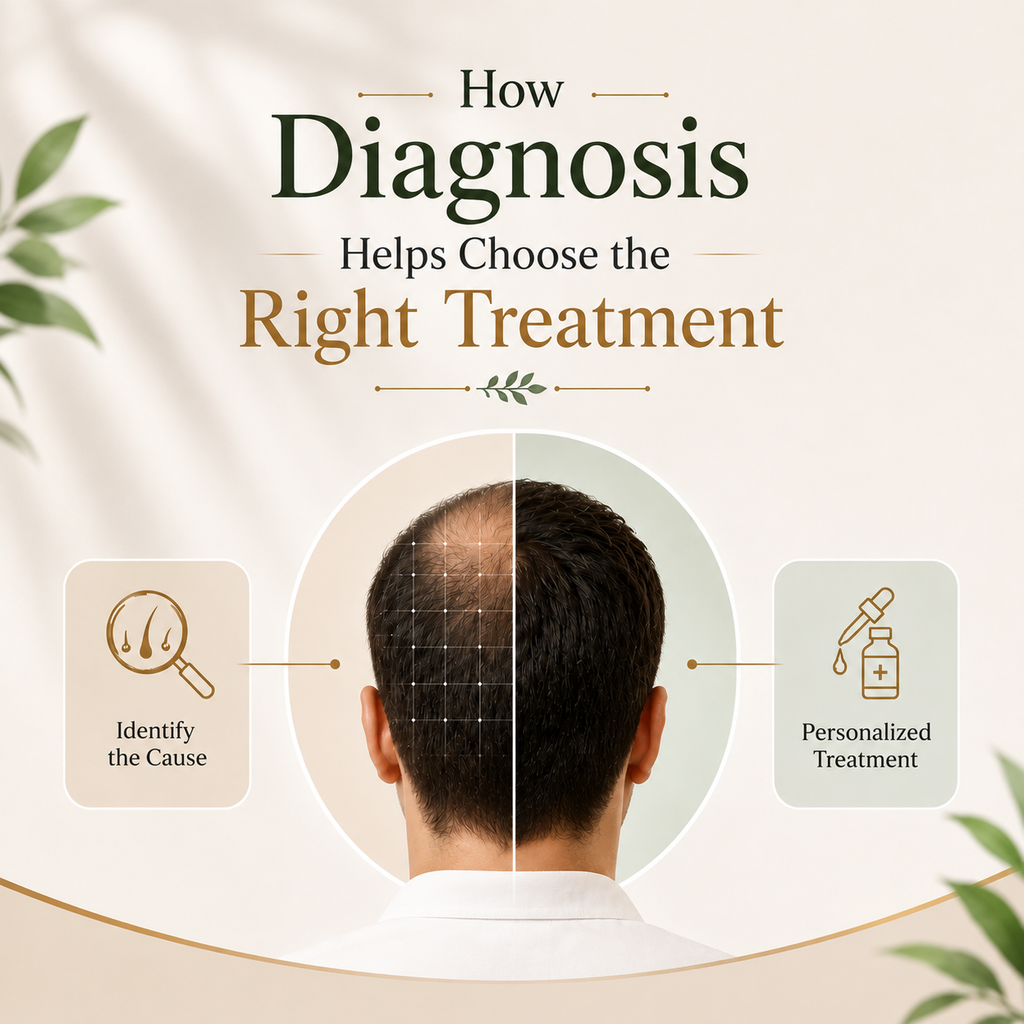
Once the cause of your hair loss is identified, your doctor can recommend treatment options that are more likely to be effective. A proper hair loss diagnosis and treatment plan may include one or more of the following:
Medical Treatment
In cases of pattern hair loss, medications may be prescribed to help slow progression and stimulate regrowth.
Lifestyle and Nutritional Correction
If deficiencies or stress are contributing factors, dietary changes, supplements, and stress management techniques may be recommended.
PRP and GFC Therapy
For suitable candidates, regenerative therapies like Platelet-Rich Plasma (PRP) or Growth Factor Concentrate (GFC) may be considered. These treatments use the body’s own healing properties to support hair follicles.
Scalp Treatments
Specialized treatments for scalp conditions can help create a healthier environment for hair growth.
Hair Transplant
For advanced or established hair loss where follicles are no longer active, a hair transplant may be discussed as a potential option.
Observation and Follow-Up
In mild cases or temporary shedding, your doctor may recommend observation with periodic follow-ups to monitor progress. The right treatment depends entirely on your diagnosis. That is why personalized planning is so important.
Why the Same Hair Loss Treatment Does Not Work for Everyone
You may have seen an advertisement or heard a friend’s success story about a particular treatment. While these stories are real, they may not apply to you.
Several factors influence how a person responds to treatment:
- Type of hair loss – Genetic balding differs from stress-related shedding.
- Severity – Early hair loss often responds better to treatment than advanced baldness.
- Duration – Long-standing hair loss may not be reversible.
- Hair follicle condition – If follicles have scarred, treatment options become limited.
- Age and health – Overall health can impact healing and response to therapy.
- Consistency – Even the best treatment requires time and commitment.
A hair thinning diagnosis helps set realistic expectations. Your doctor can tell you what is achievable based on your unique circumstances.
Can Hair Loss Be Diagnosed at an Early Stage?
Yes. In fact, early diagnosis often offers more options. If you notice any of the following, it may be worth seeking professional advice:
- Increasing hair shedding when combing or washing
- A receding hairline or an M-shaped pattern
- A widening parting in the centre of the scalp
- Thinning at the crown or top of the head
- Noticeable reduction in hair density
- Patchy hair loss or circular bald spots
Many patients in Cuttack are now seeking hair loss diagnosis in Cuttack at earlier stages, which gives them a better chance of finding suitable treatments.
When Should You See a Hair Specialist?
Not all hair fall requires immediate medical attention. Occasional shedding is normal. However, you should consider visiting a hair specialist if you experience:
- Sudden or rapid hair loss
- Patchy hair loss
- Scaly, itchy, or painful scalp
- Bald patches that are growing larger
- Excessive shedding lasting more than a few weeks
- Hair loss accompanied by other symptoms like fatigue or weight changes
A professional hair fall diagnosis can help differentiate between temporary shedding and progressive conditions that may need active management.
Diagnosis Before Treatment: Why Personalisation Matters
In the age of social media, it is tempting to try treatments that are trending or recommended by influencers. But hair loss is not a cosmetic problem that can be solved with a one-size-fits-all product.
A proper diagnosis respects the complexity of your body and your hair. It acknowledges that you are an individual—not a statistic. It also helps avoid the frustration of trying multiple treatments without seeing meaningful results.
If you are a man with receding hairline or a woman experiencing diffuse thinning, the cause and treatment approach may be completely different. That is why professional evaluation is non-negotiable.
Frequently Asked Questions (FAQs)
1. What is a hair loss diagnosis?
A hair loss diagnosis is a professional evaluation to determine the underlying cause of hair shedding or thinning. It includes medical history, scalp examination, and sometimes blood tests to identify the exact reason for hair loss.
2. How do doctors diagnose the cause of hair loss?
Doctors typically begin with a detailed history and physical scalp examination. They may perform a hair pull test or use a dermatoscope for closer inspection. Blood tests may be ordered if nutritional deficiencies, hormonal imbalances, or other medical conditions are suspected.
3. Do all types of hair loss require the same treatment?
No. Different causes of hair loss require different approaches. Genetic baldness may be managed differently than stress-related shedding or nutritional deficiencies. A proper diagnosis ensures the treatment is tailored to your specific condition.
4. When should I see a hair specialist for hair loss?
You should consult a hair specialist if you notice sudden or excessive shedding, patchy hair loss, a receding hairline, widening parting, or any scalp symptoms such as itching, redness, or pain.
5. Can early hair loss diagnosis improve treatment planning?
Yes. Early diagnosis often provides more treatment options and better chances of preserving existing hair. It allows for timely intervention before the hair loss progresses significantly.
Conclusion
Hair loss can feel like a loss of control. But the moment you decide to understand it—rather than just cover it up—you take the most powerful step forward.
Diagnosing the cause of your hair loss is not about finding a quick fix. It is about making informed choices. Whether your hair loss is genetic, nutritional, hormonal, or related to stress, identifying the cause helps you and your doctor create a treatment plan that suits your specific needs.
If you are noticing signs of thinning or shedding, do not wait. Seek a professional hair loss diagnosis before you start any treatment. And if you are in Cuttack, consulting a trusted hair specialist can help you begin your journey with confidence and clarity.
Disclaimer: The information provided in this blog is intended for general educational and informational purposes only. It is not intended to replace professional medical advice, diagnosis, or treatment from a qualified healthcare professional.
Your Hair Needs Expert Treatment Consult a Hair Specialist
Hair fall, thinning, receding hairline, or bald patches?
Don’t ignore the signs. The right treatment starts with understanding the cause of your hair loss.
Consult a hair specialist for a personalized assessment and explore treatment options suited to your hair and scalp condition.
Consult:
Dr. Chinmayee Kar
Pearl Hair Transplant
Near Reliance Fresh, CDA Sector VI, Kataka, Odisha 753014
Book an Appointment and take the first step toward healthier-looking, stronger hair.
